
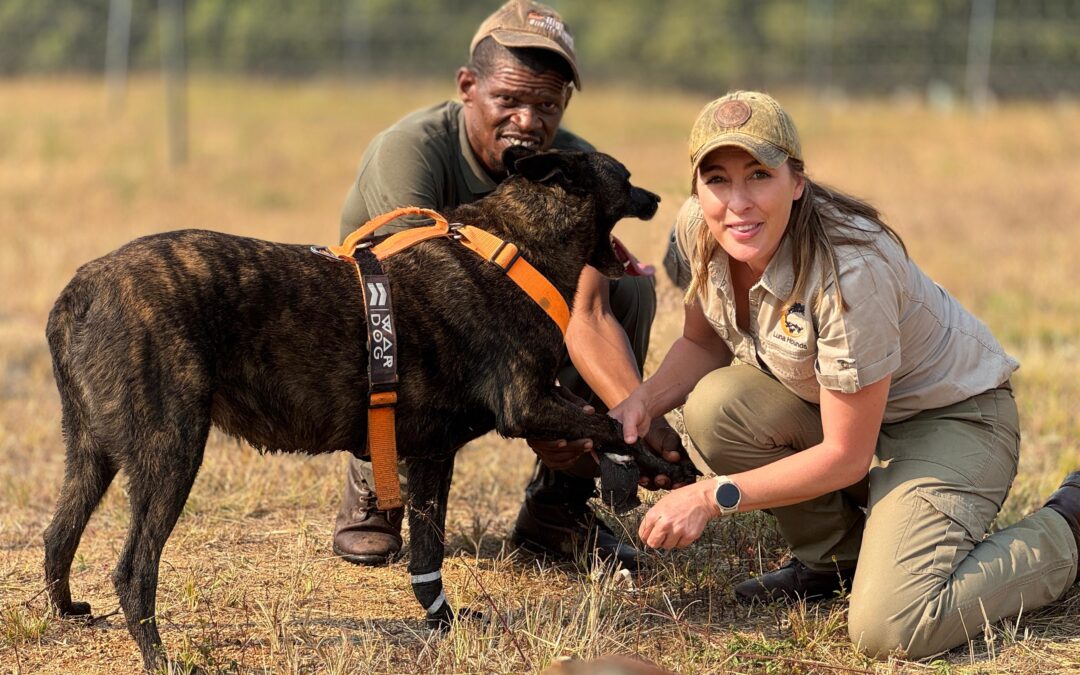
When a Luna Hounds detection dog catches the scent of macadamia felted coccid, it sits and barks. Its handler drops a GPS pin, photographs the tree and ties danger tape around its base. Somewhere in that canopy, possibly before any damage is visible, the pest has taken hold.
Sierra works for Luna Hounds, a canine unit based in the Pridelands Conservancy at Balule near Hoedspruit. Its founder and lead trainer, Robynne Oosthuizen, built her reputation in anti-poaching work, where tracking and detection dogs have become one of the most effective tools in protecting wildlife. Over the past three years, Luna Hounds has turned those same skills on agricultural pests.
The move into agriculture began with a simple question. “From our understanding of how dogs work and the incredible natural abilities they have, it felt natural to ask what more they could do,” says Oosthuizen. “They are already the last line of defence for a lot of our wildlife species. Why can’t they also protect farmers’ crops?”
Luna Hounds began discussions with Sean Moore of Citrus Research International and started working out not whether dogs could be trained to detect agricultural pests, but how. More than three years into the project, its dogs are imprinted on three pests: false codling moth, macadamia nut borer and macadamia felted coccid.
Sierra, five years old, is the unit’s most experienced detection dog. “She is our detection queen,” Oosthuizen says. “She never misses an odour and has the most wonderful barking, jumping indication when she finds the target scent. She shivers and shakes with anticipation when you put her harness on for work.”
Sergeant, just over two years old, is a Dutch Shepherd crossed with a Belgian Malinois and the rookie of the detection team. He has yet to score below 100% in training.
The dogs work with Moses Msiza, head handler for the agricultural detection dogs, who has worked with dogs for more than four years. Msiza comes from a village outside Groblersdal, where he is known as an animal whisperer and defender of animals.
Learning the scent of a coccid
Luna Hounds’ dogs have been imprinted on all the life stages of macadamia felted coccid, as well as on the full scent picture of the changes in a macadamia tree when the coccid is feeding.
“It is important to give the dogs all the necessary tools when asking them to search environments where millions of other insects are present,” Oosthuizen explains.
The coccid programme has been running for a year and a half and has involved much trial and error. At one stage the dogs were accidentally imprinted on dead tree matter, and the team spent weeks correcting the mistake. Training now uses live coccid samples as well as scent tubes that capture the odours the dogs need to learn.
In the orchard, handlers move up and down the rows while the dogs run and zigzag through the trees, following their noses towards even the faintest trace of coccid. Because of the sensitivity of a working dog’s nose, it is not necessary to search every row, and the team skips every second one.
A dedicated app tracks the handler teams as they move through each block. When a dog alerts, the handler drops a GPS pin, takes a photograph of the tree and marks its base with danger tape. A report on the alerts is then sent to the producer.
The dogs cover a hectare in less than 11 minutes. Each dog has its own indication, but generally it is a sit and a bark. “Sergeant loves to try to bite the source of the odour before he sits,” Oosthuizen says. Dogs are rotated as they tire, so the search can continue throughout the day.
Finding it before you see it
Early detection is where the dogs come into their own. Oosthuizen explains that the smaller the infestation, the more precisely the dogs can pinpoint the tree the odour is coming from. In heavily infested areas, the odour plume is so large that the dogs become frantic, unable to find a single source because to them the scent is everywhere. Handlers read this behaviour and alert the producer to a high infestation in that area.
“We don’t want to go where you know you have a high infestation. We want to find it where you don’t think you have it,” she says. “Farmers know the earlier you detect it, the more options for treatment you have.”
In training and field trials, the dogs have achieved more than 99% accuracy. In-house training records show 100% accuracy with no false alerts, although Oosthuizen is careful not to claim perfection. “They are living, breathing animals and can make mistakes,” she says.
In the field, the team searches the tree to confirm an indication. That is not always possible, as macadamia trees can be very large and a coccid may be sitting high in the canopy, carried there perhaps by a bird. In these cases, a second dog is often used to confirm the find.
Into commercial orchards
Green Farms Nut Company and Barry Christie have played a pivotal role in helping Luna Hounds take the programme to a commercial level. The unit has also tested its dogs on farms around Barberton, Hazyview and White River, identifying multiple areas that need closer investigation. Once a spray programme has been completed, Luna Hounds offers a follow-up search to confirm whether the treatment was successful.
Oosthuizen is clear about where the dogs fit into integrated pest management. “Dogs are not here to replace lab testing or agricultural experts. We are here as an early warning system for areas that need attention and investigation,” she says. In her view, visual scouting tends to pick up a problem only once damage has been done to the tree, whereas the dogs do not need to see the pest or know what it looks like. If the odour is coming from a tree, they will indicate it.
Nurseries are a particularly good fit. The trees are smaller and easier for the dogs to search, which makes nurseries an important line of defence against moving the pest to new orchards. The dogs have not yet been tested on vehicles, although Oosthuizen has no doubt they could do the work.
Weather is the main limitation. Very strong wind, heavy rain and intense heat disrupt odour and make it harder for the dogs to work. Orchard size is not a constraint, as the dogs are rested whenever they need it. “Each orchard is different, so we read our dogs and adjust the working procedures as necessary,” Oosthuizen says.
The service is priced on a sliding scale, depending on the work required and the size of the farm.
The sky is the limit
Luna Hounds has different dogs for different pests. Its false codling moth dogs remain imprinted on their target odours, although the unit’s focus in recent months has been on macadamia orchards and nurseries. Oosthuizen believes there will soon be a call for detection dogs at ports and borders to inspect outgoing consignments.
“My answer to what else the dogs could detect is that the sky is the limit,” she says. Her message to the agricultural industry is simple. “They mustn’t just see a dog, but rather a formidable detection system walking on four legs.”
Robynne Oosthuizen: [email protected], 060 625 8092.