

Recent field trials in Tzaneen have demonstrated the potential of iodine-enriched potassium nitrate (*Ultrasol®ine K Plus) to improve fruit set, fruit retention and yield in Maluma Hass avocado orchards.
The two-year study evaluated soil-applied *Ultrasol®ine K Plus against a conventional fertilization programme using potassium sulfate (K₂SO₄) and ammonium sulfate ((NH₄)₂SO₄). The results highlight the potential benefits of incorporating iodine-enriched potassium nitrate into avocado nutrition programmes.
Iodine: an emerging nutrient in crop production
Although iodine has traditionally received limited attention in plant nutrition, research increasingly recognises its potential role in supporting key physiological processes, including photosynthesis, root development and abiotic stress tolerance.
Researchers have investigated the beneficial effects of iodine in more than 30 crops, and recent studies have provided further insight into its role in plant growth and development.
These avocado trials provide promising evidence that iodine-enriched potassium nitrate can improve fruit set and yield.
Key findings from the two-year field trials
The application of *Ultrasol®ine K Plus demonstrated several advantages compared with the conventional potassium sulfate and ammonium sulfate fertilisation programme.
- Improved fruit set: Trees receiving iodine-enriched potassium nitrate consistently showed higher fruit set during the critical flowering and early fruit development stages.
- Reduced early fruit drop: Treated trees showed improved fruit retention, with fewer developing fruit lost during the early stages of fruit growth.
- 60% higher yield in year one: Under challenging growing conditions, the treatment achieved a 60% yield increase compared with the conventional programme, which recorded a yield of approximately 1,5 t/ha.
- Consistent positive response: Improved fruit set and retention were observed across the two-year evaluation period, indicating the potential value of this nutritional approach.
How does iodine support plant performance?
Iodine can be absorbed through both roots and leaves and is found in plant proteins linked to key physiological functions.
Research suggests that iodine may contribute to:
- Photosynthetic efficiency and plant metabolic activity
- Root development and nutrient utilisation
- Plant responses to environmental stress
- Overall plant growth and physiological performance.
These potential benefits may improve fruit development and retention. However, further research is needed to identify the specific mechanisms behind the responses observed in avocado trees.
Why consider *Ultrasol®ine K Plus?
*Ultrasol®ine K Plus combines potassium nitrate, a readily available source of nitrate nitrogen and potassium, with iodine in a single fertilizer formulation.
The trial findings suggest this combination may help avocado producers improve fruit set and retention during critical reproductive growth stages, potentially increasing marketable yields.
Supporting more productive avocado orchards
The results from Tzaneen demonstrate the potential of iodine-enriched potassium nitrate as part of an integrated avocado nutrition strategy.
By supporting improved fruit set, reducing early fruit losses and increasing yield potential, *Ultrasol®ine K Plus offers a promising approach to optimising orchard productivity.
Contact the local SQM representative or distributor to learn more about incorporating *Ultrasol®ine K Plus into an avocado fertilisation programme.
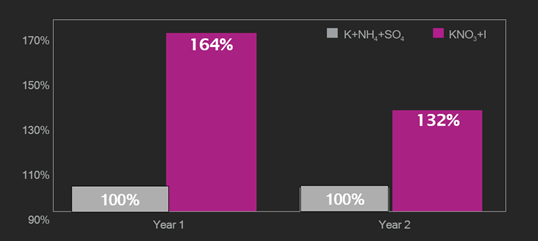
Figure 1: Fruit set 90 days after application (DAA), comparing farmers’ application and KNO₃ + I with farmers’ practice. Farmers’ K + NH₄ + SO₄ practice was set as 100%.
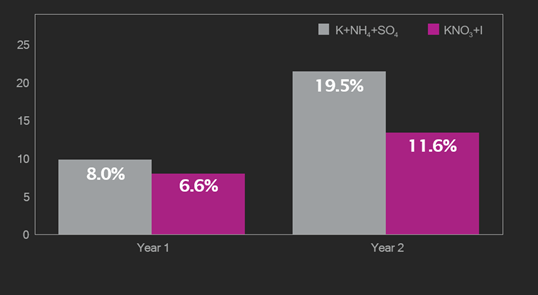
Figure 2: The percentage of fruit dropped between 60 and 90 DAA, comparing farmers’ application and KNO₃ + I with farmers’ practice of K + NH₄ + SO₄.
*Reg No K11316 Act 36/1947. Registration holder: Sociedad Quimica y Minera (Africa) (Pty) Ltd SQM Disclaimer: The information contained herein is given to the best of SQM’s knowledge and is believed to be accurate. The conditions of use and application of the suggested formulae and recommendations are beyond SQM’s control. No warranty is made on the accuracy of any data or statements contained herein. SQM specifically disclaims any responsibility or liability relating to using the suggested formulae and recommendations and shall under no circumstances be liable for any special, incidental or consequential damages arising from such use.