Netafim
From producer to consumer, everyone is well aware of the statistics around water scarcity, agricultural water use, and increased food demand driven by population growth. For many years, the challenge has been clear: produce more food while continuously increasing water-use efficiency.
Dr Zanele Ntshidi, node manager of Arid Lands at the South African Environmental Observation Network, advocates for smart water use in agriculture by reminding stakeholders that 80% of South Africa’s land mass falls within semi-arid to arid zones.
“It is imperative that we continuously increase water-use efficiency in agriculture. Enhancing efficiency ensures stable and improved crop yields. It allows for increased production using less water, thereby mitigating the impacts of droughts. By further improving efficiency and getting more crop yield per drop of water, agricultural systems can become more resilient, sustainable, and capable of feeding the growing population of South Africa.”
She adds that key highlights of her research, which focus on long-term observations and developing decision-support tools that assist with irrigation scheduling, substantiate the benefits of adopting smart water-use technologies such as precision irrigation and soil moisture monitoring. By ensuring that crops are replenished with the exact amount of water required, non-beneficial water losses are reduced, over-extraction of freshwater sources is prevented, and the carbon footprint of food production is lowered.
Ntshidi says that precision irrigation plays a fundamental role in climate-resilient agriculture by transitioning water management from generalised approaches to data-driven, site-specific systems.
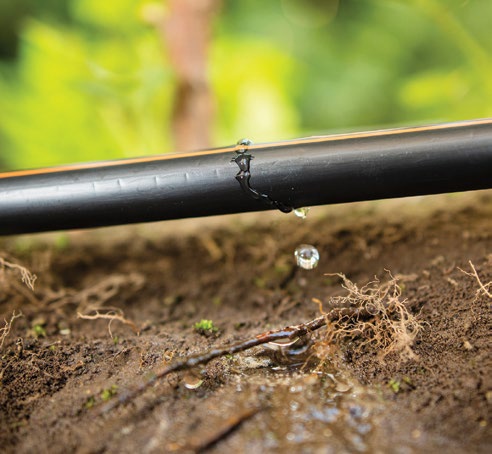
“It acts as a key adaptation strategy in water-scarce regions by delivering precise amounts of water directly to the root zone, reducing waste, and improving crop resilience against droughts and unpredictable rainfall patterns. Through precision irrigation, a producer can be certain that the applied water is used for plant production rather than non-beneficial use that leads to losses such as evaporation.”
Holistic precision approach
In this context, Charl van Reenen, agronomy manager at Netafim Southern & East Africa, calls for a holistic approach to precision irrigation. “Precision irrigation and the efficient use of water in agriculture should not be viewed as a silo in the mission towards improved resource-use efficiency on the farm. It is one component of a broader precision agriculture approach.”
Van Reenen explains that precision irrigation integrates with all other precision inputs and actions. The implementation of a precision irrigation system, and the planning that goes into it, also enables the precise use of other inputs. It allows for the timely and accurate execution of actions based on insights from other precision tools, such as soil analyses and sensor data. Whether through more efficient fertiliser use, reduced disease pressure, or irrigation based on phenological phases, precision irrigation leads to reduced risks and improved sustainability of the entire farming operation.
When approaching precision irrigation as part of a total precision agriculture system, the interaction between different precision inputs becomes clear. “One example is the interaction between soil analyses, mapping, and precision irrigation. Knowledge gathered from soil analyses informs scheduling approaches based on soil differences. In turn, the management tools provided by precision irrigation systems allow producers to respond to this data and irrigate according to crop requirements and soil characteristics at block level.”
Similarly, precision irrigation adds value to crop and cultivar selection. With the correct equipment and scheduling approach, each plant can be irrigated according to its requirements. Van Reenen adds that precision irrigation extends beyond driplines, filters, and controllers. It is about the collection of data, expert interpretation, and precise execution of decisions based on that data.
The importance of precision irrigation as part of a broader system becomes clear when considering the role of water in crop growth. Water drives nutrient uptake. It is critical to root development, flowering, and fruit set, all of which directly impact yield quality. If water is not managed correctly, the benefit of other inputs is lost, and plant potential is constrained.
The producer’s perspective
When discussing water efficiency, the message can easily focus only on saving water. However, conversations with precision irrigation users highlight the value of precise water management for improved results in the field.
Jonathan Miller, farm manager at Redberry Farm near George, explains that their water-use philosophy is based on providing plants with exactly what they need when they need it, without waste.
“The aim is to produce good-quality fruit and profitable yields while farming sustainably. It goes far beyond saving water. With crops where consistent moisture is critical, such as strawberries and kiwis, proper irrigation management supports consistent growth and improves nutrient-use efficiency. It helps manage inputs while maintaining yield and fruit quality.”
Jantjie Jonker, owner of Jakkalsvlei Wine Farm near Herbertsdale, highlights precision irrigation as a management tool. “Water is limited, and drip irrigation allows optimal use of available resources. It also enables a focus on grape quality rather than quantity. Plant moisture can be managed precisely to control yield and canopy growth, giving greater control over vineyard productivity.”
Water mind shifts
Marco Appel, agricultural economist at Netafim Southern & East Africa, emphasises the importance of a long-term perspective in irrigation decisions. Two important mind shifts are required, he says. Firstly, water should not be viewed as an input, but as a strategic asset. Like land and capital, it must be protected and invested in. This is about long-term water stewardship.
“The second shift is understanding the true cost of water. It extends beyond tariffs and includes pumping, maintenance, labour, and other operational costs. These factors must be considered when making irrigation investment decisions and when weighing capital costs against long-term benefits and savings. When combined with a long-term, data-driven approach, the economic value of precision irrigation becomes clear.”
More than the sum of its parts
The principle is simple: one plus one is more than two when different precision practices work together to unlock greater potential. Van Reenen advises that a holistic view is essential during the planning phase to achieve this outcome. Precision irrigation requires systems that are designed and installed with all resources and production goals in mind to ensure optimal production.
“When developing a new farming project, several questions must be answered, and multiple experts must contribute. Irrigation planning is only one aspect and should not be approached in isolation. It must be informed by data from other areas of precision agriculture while also contributing to decision-making across the system.”