
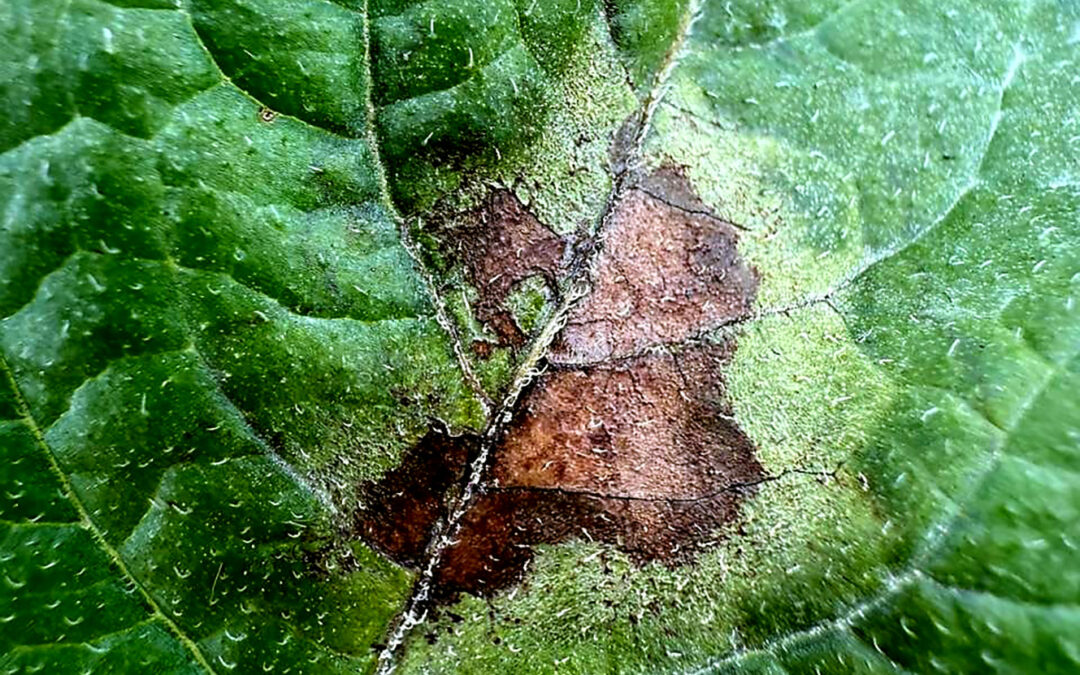
Picture a flawless potato season in South Africa, where neither early- nor late blight dares to truncate a crop’s vibrant cycle. Plants push boundaries, stacking 5 to 7 tons per hectare weekly in those crucial late stages, as revealed by Dr Christine Jones of UK’s Dyson Farming Research. Optimise the protection spraying programme against early- and late blight, and the producer could be one step closer to reaching that perfect-season dream.
Yet, blights strike fear with good reason. Late blight (Phytophthora infestans), an oomycete scourge, erupted in Europe in 1845, likely hitchhiking from Central America on infected tubers. It ravaged fields continent-wide, sparking the “last European subsistence crisis” of 1845-1850. Ireland suffered most: potatoes sustained 60% of diets for 8,5 million people. In 1845, 40% of harvests rotted; by 1846, total crop wipeout ignited the Great Famine (An Gorta Mór), claiming one million lives to starvation and typhus, while 1 to 1,5 million emigrated, slashing the population by half by 1855.
Early blight (Alternaria solani), meanwhile, creeps in as crops age, eroding defences and shredding foliage in warm, humid climates. Unchecked, it curtails photosynthesis and tuber quality, stalling growth prematurely.
In South Africa’s 50 000 hectares of potato lands, threats vary. Late blight simmers in misty highlands like KwaZulu-Natal, where sub-optimal climates limit outbreaks – but left unmanaged on susceptible cultivars, it can gut 50% to 70% of yields locally. Early blight, however, reigns more insidiously across warmer regions, from Limpopo to the Western Cape. A landmark survey in 2001/02 by Prof Jacquie van der Waals, Prof Lise Korsten, and Dr Freddie Denner – spanning the 10 top production areas (Limpopo, Free State, North West, Northern Cape, Mpumalanga, Gauteng, Western Cape, Eastern Cape, KwaZulu-Natal, and the Sandveld) pegged average losses at 20%, ranging 1% to 60%.
How do we fight these diseases? Philagro SA imports and offers precision tools to the producer’s arsenal. While weather remains a gamble, the producer orchestrate seed quality, fertilizer timing, biostimulants, and – through Philagro – elite fungicides. Enter the dynamic pair: Sumisclex® SC for early blight and Leimay® 200 SC for late blight, both Japanese-engineered, upholding global gold standards.
Sumisclex® SC, produced by Sumitomo Chemicals, packs procymidone (250 g/L) in a soluble concentrate for effortless mixing. This Group 2 dicarboximide, in conjunction with its mixing partner, thwarts pathogen development at vital junctures, delivering foliar armour. Buffer water to pH 4.5-5.5 for optimal efficacy; apply two sequential sprays at 500-1 000 ml/ha ground (600-1 200 ml/ha aerial) with a pre-harvest interval of 35 days in potatoes. Tailor water volumes per label for coverage and alternate to dodge resistance.
Complement it with Leimay® 200 SC, produced by Nissan Chemical Corporation, wielding amisulbrom (200 g/L) – a Group 21 sulfoamide that ceases pathogen respiration. Registered as a ground-only application at 375 ml/ha in 375-750 L water/ha (two applications with a pre-harvest interval of 14 days in potatoes). Together with its tank mixing partner, Leimay® 200 SC ensures a rapid, enduring shield against late blight.
The magic unfolds in tandem: weave them into an 8-12-week spray programme, alternating with different chemical group fungicides for effective resistance management. This constructive collaboration can optimise the producer’s crop protection, bringing him or her one step closer to reaching that perfect-crop dream. It is integrated pest management at its finest – seed selection, biological inputs, disease scouting, spray timing, and these two powerhouses aligned.
In South Arica’s sun-baked soils, Sumisclex® SC and Leimay® 200 SC are not add-ons; they are an unbreakable alliance, transforming crop-vulnerability into crop-victory by helping the producer beat the constant attack of blights.
READ THE LABEL BEFORE USE. | SUMISCLEX® SC | Reg. No. L6377, Act No. 36 of 1947 | Procymidone (Dicarboximide) (250 g/L) | WARNING | Suspected of damaging to fertility or the unborn child. | Philagro SA (Pty) Ltd. | Reg. No. 1998/010658/07 | Postnet Suite #378, Private Bag X025, Lynnwood Ridge 0040 | Tel: 012 348 8808.
READ THE LABEL BEFORE USE. | LEIMAY® 200 SC | Reg. No. L10884, Act No. 36 of 1947 | Amisulbrom (Sulfoamide) (200 g/L) | WARNING | Very toxic to aquatic life with long lasting effects. | Philagro SA (Pty) Ltd. | Reg. No. 1998/010658/07 | Postnet Suite #378, Private Bag X025, Lynnwood Ridge 0040 | Tel: 012 348 8808